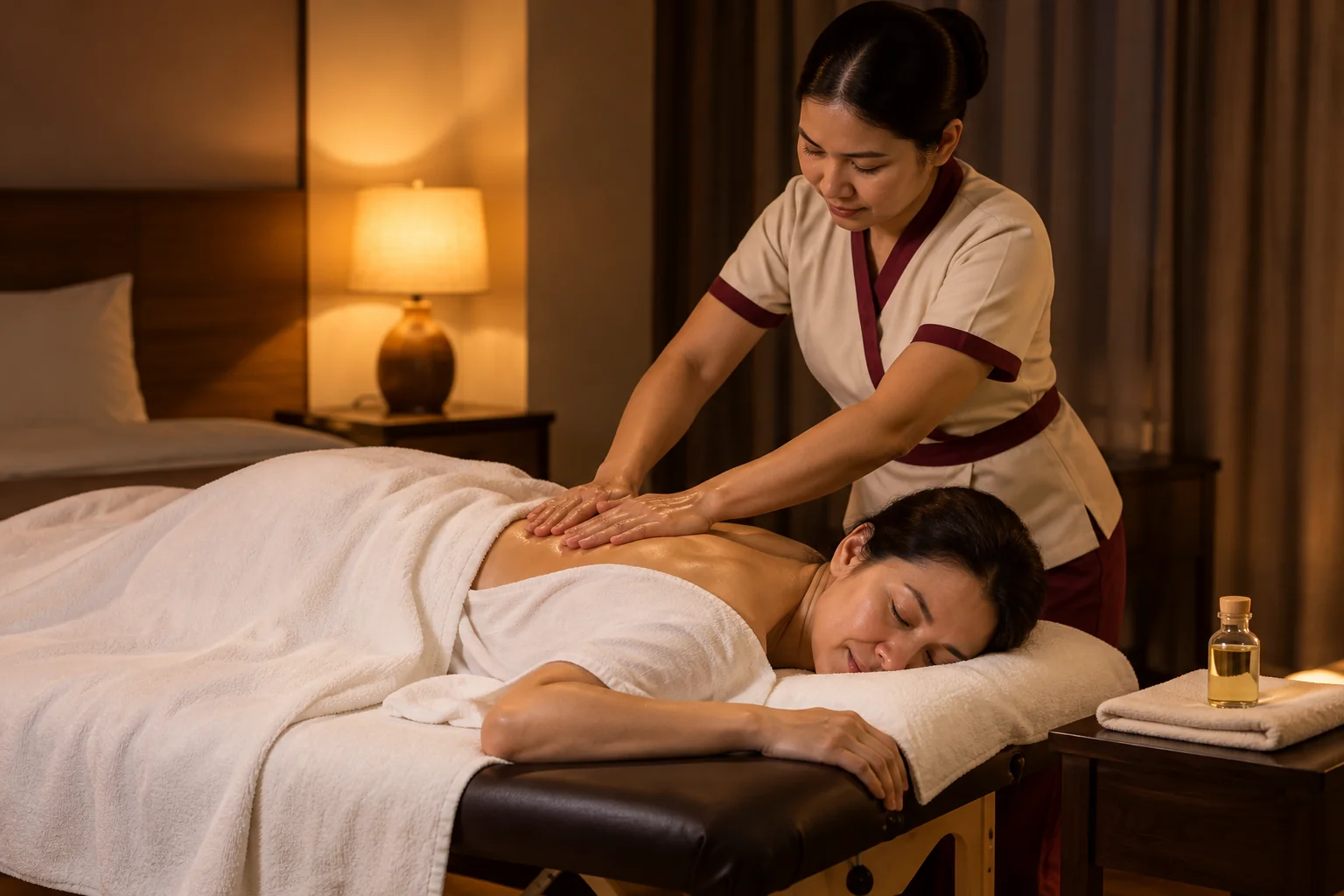
Aromatherapy massage is the treatment people book when the problem is not really their back. It is the lightest and slowest of the oil treatments, the scent is part of the work rather than a decoration on it, and it is aimed at a nervous system rather than at a muscle.
That makes it excellent for some things and close to useless for others, so it is worth knowing which is which before you book.
What makes it different from the other oil treatments
Two things: the oil, and the pace.
The oil is a neutral base with essential oils blended into it, so the treatment has a scent and that scent is in the room for the whole session. The pace is deliberately slow — long, light, repetitive strokes with far less variation than coconut oil massage and nothing like the pressure of deep tissue.
The repetition is the mechanism. A predictable, unvarying stroke is the opposite of what a tense body is braced for, and after fifteen or twenty minutes most people stop anticipating it. That is the state the treatment is trying to produce, and firmer work would prevent it.
It runs ฿1,200 for sixty minutes, ฿1,500 for ninety, ฿1,800 for two hours and ฿2,400 for three. Ninety minutes is the length we would suggest if you are choosing: an hour is enough to relax but the second half is where the switching-off tends to happen.

When to choose it
It is the right treatment when the complaint is about state rather than tissue:
- You cannot sleep. Not a cure for insomnia, but a late-evening session is a reliable way to arrive at bedtime in a different condition than you otherwise would.
- Work has been relentless. When the issue is weeks of pressure rather than one bad posture.
- You find firm massage unpleasant. A lot of people do and assume massage is simply not for them. This is the treatment that is not firm.
- You have had a shock or a hard few weeks. It asks nothing of you.
When to choose something else
It will not do much for a specific, established tightness. If you have a knot between your shoulder blades that has been there since June, a light flowing treatment is pleasant and will not reach it. Office syndrome massage at ฿1,200 for an hour or deep tissue at ฿1,400 are the treatments built for that, and why one massage helps and the next does not is largely about this mismatch.
It is also the wrong choice if scent is a problem for you. Some people find any scented oil cloying, particularly in a small air-conditioned room, and if that is you then Thai oil massage at ฿1,000 gives you the same flowing treatment with plain unscented oil. Say so when you book rather than enduring it.

The practical questions
Can you choose the blend? Within reason — tell us on the form whether you want something calming for the evening or something lighter and brighter, and the therapist will bring accordingly. We do not offer a menu of named blends to pick from, and anyone who tells you a particular essential oil treats a medical condition is overstating what is known.
Will you smell of it afterwards? Faintly, yes, for a few hours. Worth knowing if you have booked it before a dinner rather than before bed.
Is it safe in pregnancy? Several essential oils are not recommended during pregnancy, so tell us if you are pregnant and we will use a plain base oil instead. Also tell us about asthma, migraine triggered by scent, or any fragrance allergy — all three are common and all three are easy to work around with notice.
What does it need in the room? A table, so about two metres by one of clear floor plus standing room, somewhere to change and a door that closes. A quiet room matters more for this treatment than for most, and dim light helps.
What the scent does, honestly
Aromatherapy carries a certain amount of claim-making, and it is worth separating what is reasonable from what is not.
Reasonable: scent has a direct and well-established route to the parts of the brain involved in memory and emotional response, which is why a smell can change how a room feels faster than anything you can see. In a treatment whose whole purpose is to get a wound-up person to stand down, that is genuinely useful rather than decorative.
Also reasonable: a consistent scent becomes associated with the state you were in last time you smelled it. People who book this regularly often find later sessions settle them faster, and that is a perfectly ordinary bit of conditioning rather than anything mysterious.
Not reasonable: that a particular oil treats a medical condition, corrects a hormone, or does anything to an illness. Anybody telling you which essential oil to use for a named diagnosis is overstating what is known, and we are not going to do that. What this treatment offers is a light, slow, pleasant hour in a scented room, and that is worth paying for on its own terms.

Getting the most out of the hour
A few things make a measurable difference to this treatment in particular, because so much of it depends on your state rather than on the technique.
- Book it with nothing after it. This is the treatment most spoiled by having somewhere to be at eight.
- Cool the room beforehand. Half an hour of air conditioning before the therapist arrives, particularly in hot season — a scented oil in a hot room is cloying rather than calming.
- Dim the lights and put the phone somewhere else. Obvious, routinely ignored.
- Say if the pressure is too light. It is meant to be light, but light is not the same as insubstantial, and there is a range within it.
- Do not shower immediately. Give it twenty minutes if you can.
Making it work at home
This is the treatment that benefits most from being delivered where you live, because the twenty minutes after it are part of it. In a spa you get dressed, settle up and walk into traffic; at home you do not have to do anything at all.
Book it late if you can. We work around the clock, with ninety minutes' notice as the earliest arrival, and an evening session that ends an hour before you sleep is the version of this treatment that works best. There is no travel surcharge in any of the twelve districts we cover — the service areas page has arrival estimates for each.
If you are weighing it against the other oil treatments, massage at home versus going to a spa covers the setting and the home page lists every treatment with its prices. When you have decided, send a request and we will confirm a therapist before anything is fixed.
Frequently asked questions
Can I choose the blend?
Within reason. Tell us on the form whether you want something calming for the evening or something lighter and brighter and the therapist will bring accordingly. We do not offer a menu of named blends, and we will not tell you that a particular oil treats a medical condition, because that overstates what is actually known.
Is aromatherapy massage safe during pregnancy?
Several essential oils are not recommended during pregnancy, so tell us and we will use a plain base oil instead, which keeps the treatment and removes the concern. The same applies to asthma, migraine triggered by scent and any fragrance allergy. All are common and all are easy to work around with notice.
Will I smell of it afterwards?
Faintly, for a few hours. That is worth knowing if you have booked it before a dinner rather than before bed. If scent is a problem for you in any amount, Thai oil massage at 1,000 baht gives you the same flowing treatment with plain unscented oil.
Will it help a knot in my shoulder?
Not much. A light flowing treatment is pleasant and will not reach an established tightness. Office syndrome massage at 1,200 baht for an hour or deep tissue at 1,400 are the treatments built for that. Choosing aromatherapy for a specific muscular complaint is the commonest reason somebody concludes that massage does not work for them.
What length should I book?
Ninety minutes at 1,500 baht if you are choosing. An hour is enough to relax, but the second half is where most people stop anticipating the stroke and genuinely switch off, and that is the state the treatment exists to produce. Book it with nothing afterwards if you can.


