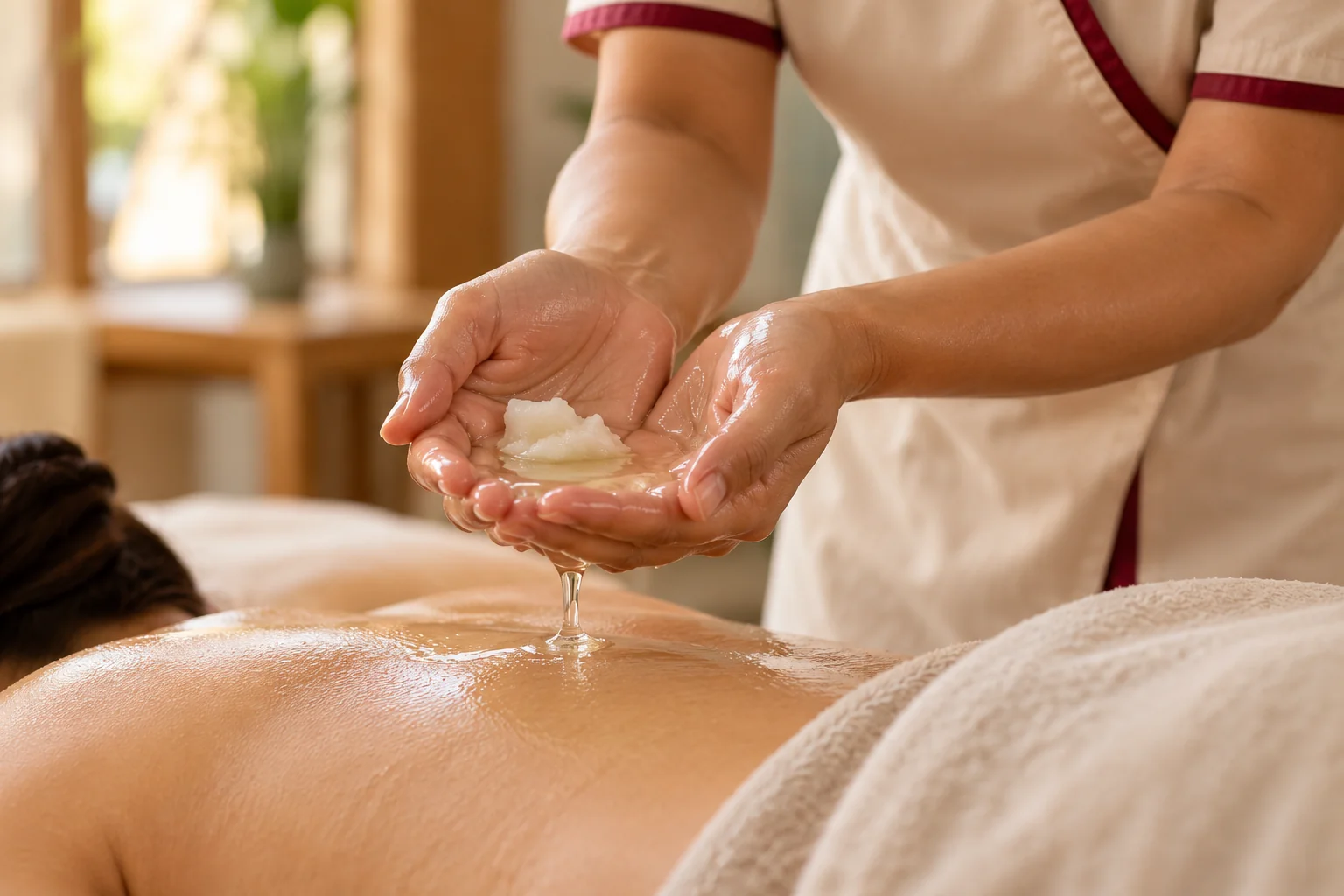
Coconut oil is the oil Thailand reaches for, and visitors often assume that is tradition or marketing. It is mostly neither. It is a practical answer to a hot, humid climate, and it behaves differently on skin from the oils used in colder countries.
Why coconut oil rather than anything else
Three properties matter, and they compound in a climate like this one.
It is light. Coconut oil is thinner than the heavy base oils used in European massage and it sinks in rather than sitting on the surface. In a room at thirty degrees with the humidity up, a heavy oil does not absorb; it stays on you, mixes with sweat, and the treatment stops feeling clean about twenty minutes in.
It melts at close to body temperature. It arrives solid or semi-solid and liquefies in the therapist's hands, so it goes on warm every time with nothing to heat and nothing to go cold between strokes.
It washes off. This sounds trivial and it is the thing guests comment on most. You are not committed to a shower immediately afterwards, and you are not sleeping on a towel.
There is also the simple fact that it grows here. Coconut oil in Thailand is a local, inexpensive, everyday product rather than an imported speciality, which is why it became the default rather than a premium option.

What a coconut oil massage is like
Coconut oil massage is a flowing, full-body table treatment: long strokes along the back and limbs, moderate pressure, continuous rather than targeted. You undress to whatever you are comfortable with and are covered by a towel throughout, with only the area being worked uncovered.
Pressure is in the middle of our range. Firmer than aromatherapy massage, which is deliberately light and slow; considerably gentler than deep tissue. If you want a full-body treatment that leaves you relaxed rather than worked over, this is the middle of the three.
It runs ฿1,200 for sixty minutes, ฿1,500 for ninety, ฿1,800 for two hours and ฿2,400 for three.

Coconut, plain oil or aromatherapy
These three are the oil treatments and the difference between them is genuinely about the oil, not about the technique.
| Treatment | The oil | Sixty minutes |
|---|---|---|
| Thai oil massage | Warm plain oil, unscented | ฿1,000 |
| Coconut oil massage | Coconut, light, faint natural scent | ฿1,200 |
| Aromatherapy massage | Base oil with essential oils, scented | ฿1,200 |
Thai oil massage is the one to choose if scent bothers you or you have reacted to products before — plain oil and nothing in it. Coconut sits between the two: a faint natural smell, nothing added. Aromatherapy is the scented one, and the scent is part of the treatment rather than a flourish on it.
For a first oil massage, plain Thai oil at ฿1,000 is the cheapest way to find out whether you like being worked on with oil at all.
Skin, allergies and the honest caveats
Coconut is a tree nut, and although true coconut allergy is uncommon it exists. If you have a tree nut allergy, tell us in the booking notes and choose plain oil instead — this is not a situation for finding out.
Coconut oil is also comedogenic, which in plain terms means it can block pores. On a back that is already prone to breaking out, a full-body coconut oil treatment is not the kindest choice, and plain oil or a treatment with no oil at all is the better call. Traditional Thai massage uses none and is worked through clothing.
And the general rule that applies to every oil treatment: broken skin, a fresh sunburn, a rash or a recent tattoo all need mentioning before the session rather than during it. Put it in the notes on the form. It changes which areas the therapist works and is much easier to deal with before they arrive.

What the session itself is like
If you have not had an oil treatment before, the shape of it is worth knowing in advance, because most of the hesitation people have is about the undressing rather than the massage.
You undress to whatever you are comfortable with — most people keep underwear on, and some prefer to keep more — and get under a towel while the therapist is out of the room or turned away. From then on you are covered throughout. Only the part being worked is uncovered, and the towel is moved and replaced as the therapist goes: back, then one leg, then the other, then arms, then the front if you have asked for it. Nothing is uncovered that is not being worked on.
You lie face down to begin with, usually for a little over half the session, then turn over. The therapist will tell you when. There is a face hole in the table, so you are not lying with your head turned to one side for forty minutes.
Say something if the pressure is wrong. This is the single most useful thing a guest can do and the thing people are most reluctant to do. Too firm is not something to endure politely, and too light means you are paying for an hour that is not doing what you wanted. Either way one sentence fixes it immediately, and no therapist minds being told.
Afterwards
Coconut oil absorbs fairly quickly, so you will not be slick when you stand up — faintly moisturised rather than oily, which is the main practical advantage it has over heavier oils.
You do not need to shower straight away, and there is an argument for not doing so: the oil is doing something useful on skin that spends its days in air conditioning. If you are going out, give it twenty minutes and it will have settled.
What does matter is not standing up and immediately doing something. The twenty minutes after a massage are part of it, and they are the main reason having one at home beats having one somewhere you then have to leave. Drink some water, sit for a bit, and do not book anything for an hour afterwards if you can help it.
On linen: your therapist brings fresh towels and linen for the table and takes them away again, so your own sheets are not involved at all. If you have had the treatment on a mat on the floor rather than a table, the same applies.
Booking it
Coconut oil massage needs a table and therefore the floor space for one, which makes home or a condominium its natural setting — about two metres by one plus standing room. It works in a hotel room with the space for it, and not at an office, for the obvious reason.
We cover twelve districts with no travel surcharge in any of them, and the service areas page gives an arrival estimate for each. If you are still deciding between the oil treatments, a newcomer's guide to Thai massage styles lays all of them out side by side.
If it is the scent you are after rather than the oil itself, aromatherapy massage comes at the same question from the other side. You can send a request once you have chosen, and the full list with prices is on the home page.
Frequently asked questions
Why does Thai massage use coconut oil?
Mostly for practical reasons rather than traditional ones. It is light enough to absorb in a hot, humid room where a heavy oil would sit on the skin and mix with sweat, it melts at close to body temperature so it goes on warm, and it washes off easily. It also grows here, so it is an everyday product rather than an imported speciality.
What is the difference between coconut oil and aromatherapy massage?
The oil, rather than the technique. Coconut oil massage uses coconut oil with only its own faint natural scent. Aromatherapy uses a neutral base with essential oils blended in, so the treatment is scented and the scent is part of it. Both are 1,200 baht for sixty minutes, and aromatherapy is the lighter and slower of the two.
Can I have it if I have a nut allergy?
Tell us before you book and choose plain oil instead. Coconut is a tree nut, and although true coconut allergy is uncommon it exists. Thai oil massage at 1,000 baht uses warm plain unscented oil and is the straightforward alternative. This is not a situation for finding out during the session.
Will I need to shower straight afterwards?
No, and there is an argument for not doing so. Coconut oil absorbs fairly quickly, so you will be faintly moisturised rather than slick when you stand up. If you are going out, twenty minutes is enough for it to settle. Your therapist brings fresh linen and towels and takes them away, so your own sheets are not involved.
Is it suitable for sensitive or acne-prone skin?
Coconut oil is comedogenic, which means it can block pores, so a full-body coconut treatment is not the kindest choice on a back that already breaks out. Plain oil is better, or traditional Thai massage, which uses no oil at all and is worked through clothing. Mention any skin condition, recent tattoo or sunburn in the booking notes.


