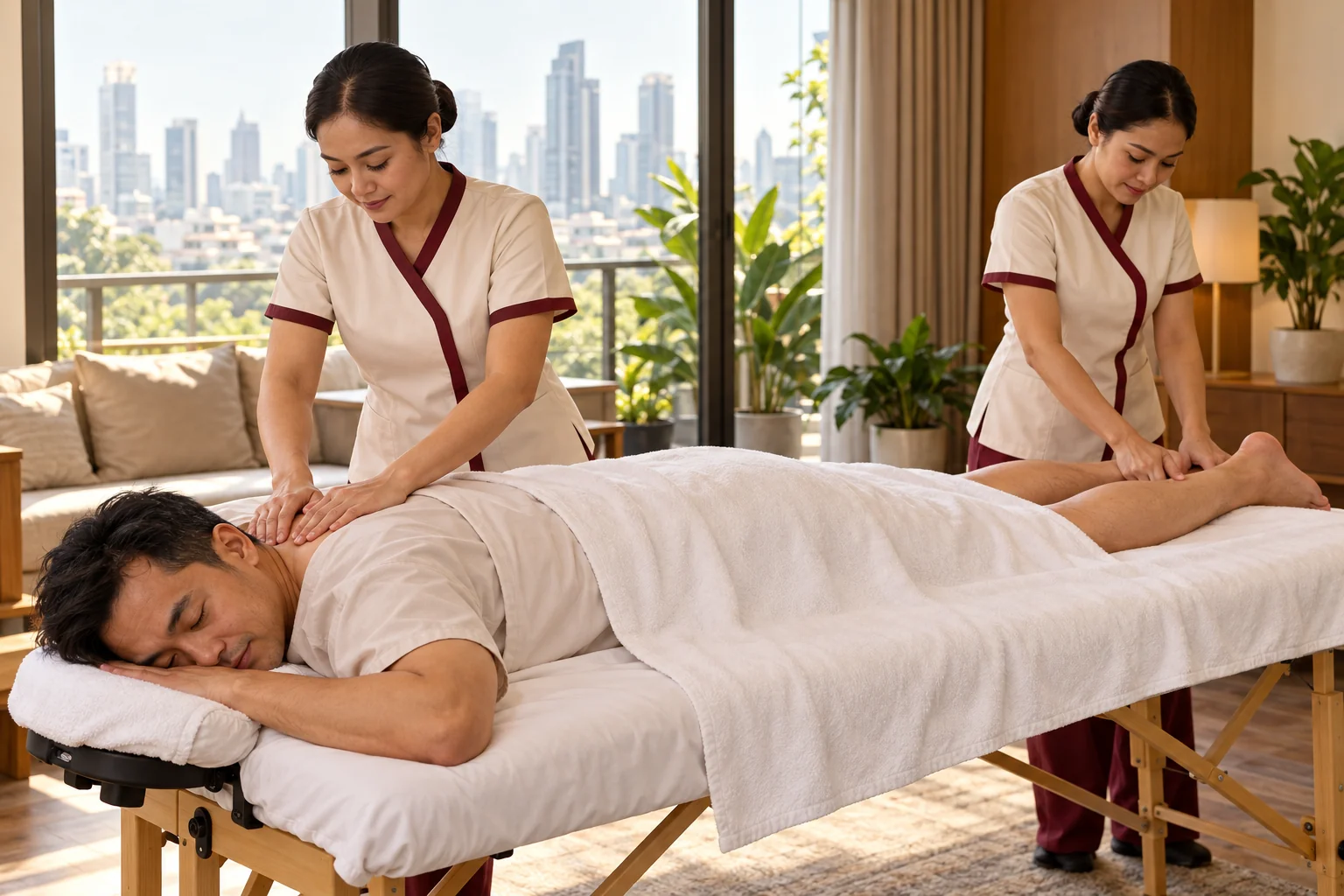
Four hands massage is two therapists working on you at once, in time with each other. It is the treatment people are most curious about and least likely to book, usually because they assume it is an upgrade with a surcharge attached. It is not an upgrade. It is a different treatment, and the price reflects two people being there.
What two therapists change
The obvious thing is coverage: your shoulders and your calves are being worked at the same moment rather than twenty minutes apart. The less obvious thing is what that does to your attention.
In an ordinary massage you can follow what is happening. The hands move from one place to the next and some part of you tracks them, predicts them, braces slightly. With four hands moving in two places at once that tracking gives up within a few minutes, because there is nothing coherent to follow. People describe the result as switching off faster and harder than they do in a single-therapist session, and that is the actual point of the treatment.
It is also, straightforwardly, more treatment per minute. Sixty minutes of four hands covers roughly what ninety minutes of two hands covers, which matters if time rather than money is the constraint.

What it costs, and why that figure
Two therapists attend, and both are paid for their time, so the price is the two-therapist price:
| Length | Price |
|---|---|
| 60 minutes | ฿3,000 |
| 90 minutes | ฿3,200 |
| 120 minutes | ฿3,600 |
| 180 minutes | ฿4,400 |
It is worth being blunt about this, because half-price figures for four hands circulate and they are per therapist rather than per session. A figure near half of each number above is one therapist's share of the session rather than the price of the session. Two therapists are the treatment, not an option added to it, so there is no version of this at the single-therapist rate.
Notice how flat the curve is after the first hour. Ninety minutes is ฿200 more than sixty, and two hours is ฿600 more. Most of the cost is in getting two therapists to your door at the same time; the extra minutes are comparatively cheap. If you are going to book it at all, ninety minutes is much better value than sixty.
Who it suits, and who it does not
It suits people who cannot switch off. If your usual complaint about a massage is that your head kept working through it, this is the treatment that addresses that directly.
It suits people short of time, for the coverage reason above. And it suits anyone who wants something to feel like an occasion — it is the treatment people book for a birthday far more often than for a bad back.
It suits you less well if you have one specific problem. Four hands is a flowing, whole-body treatment; it is not where precise work on a particular knot happens.
For that, deep tissue massage at ฿1,400 for an hour or office syndrome massage at ฿1,200 will do more, for less. Deep tissue or Thai massage for a stiff back covers that choice.
And it suits you less well if being touched by two people at once sounds stressful rather than relaxing. That is a reasonable reaction and not an unusual one.

The practical side
Space first: two therapists need standing room on both sides of one table, so it needs more clear floor than a single session — about three metres by two in practice. Less than a couples booking needs, because there is only one table, but more than you might assume.
Scheduling second: two therapists have to be free at the same time and in the same area. The ninety-minute minimum notice still applies, but this is the booking most likely to come back with an alternative time rather than a straight yes, so ask earlier in the day if the timing matters.
It can be worked at a hotel as well as at home, and it is one of the treatments available at an office, where it is done seated and through clothing. There is no travel surcharge in any of the twelve districts we cover — the service areas page lists them with arrival estimates.
What the synchronisation is actually like
The first few minutes are the strange part. Two sets of hands start at different ends of you and your attention tries to follow both, which does not work, and for a minute or two that is mildly disorienting rather than relaxing.
Then it stops. Most people describe a point somewhere in the first ten minutes where the tracking simply gives up — there is nothing to anticipate, so the anticipating stops — and that is the state the treatment is built to produce. It arrives faster than it does in a single-therapist session, and it is the reason people who struggle to switch off tend to prefer this to anything else on the list.
The two therapists work in mirror most of the time: both arms, both legs, both sides of the back. They are not improvising independently, and the effect is more like one treatment with twice the coverage than like two treatments happening at once.
It is not silent — there is some quiet coordination between them — and it is not a conversational hour. As with any treatment, say something if the pressure is wrong on either side. Two therapists means two people who need telling, and it is entirely normal to want one firmer than the other.

Where it can be done
At home or in a condominium is the natural setting, and the one we would suggest for a first time: you can lie still afterwards rather than going anywhere, and the space question answers itself in most living rooms.
In a hotel room it needs more space than a single treatment — one table, but two people standing around it. A junior suite or a larger room is fine; a standard double with the bed, desk and luggage rack in place is usually not. Which treatments fit in a hotel room goes through the measurements.
At an office it is one of the treatments available, worked seated and through clothing in the chair the therapist brings. That is a genuinely different proposition from the table version — shorter, through clothing, and aimed at the shoulders and upper back rather than the whole body — but it is the same idea and it is striking in a wellness-day context.
If you are trying it once
Book ninety minutes rather than sixty, for the pricing reason above, and book it at home rather than in a hotel room if you have the choice — the space question answers itself and you can lie still afterwards instead of going anywhere.
Tell us on the form if it is your first time. It changes nothing about the treatment, but it is useful for the therapists to know that the synchronisation is going to be unfamiliar.
The four hands page has the full description, you can send a request when you are ready, and every treatment with its prices is listed on the home page.
Frequently asked questions
Why does four hands massage cost more?
Because two therapists attend and both are paid for their time. It is 3,000 baht for sixty minutes, 3,200 for ninety, 3,600 for two hours and 4,400 for three. Two therapists are the treatment itself rather than an option added to it, so there is no version of it at a single-therapist rate.
I have seen it advertised for about half that. Why?
That figure is one therapist as half of the session. Our per-therapist figures are 1,500 for sixty minutes and 1,600 for ninety, and a customer pays double because the minimum is two therapists. Those same numbers are genuine full prices for other treatments, which is exactly what makes the confusion easy.
How is it different from a couples massage?
Four hands is two therapists on one person, working in time with each other. A couples session is two therapists on two people, each working independently on whichever treatment that person chose. Different treatments, different prices, and only the couples one needs space for two tables.
Is it worth it if I only want one knot worked on?
Probably not. Four hands is a flowing, whole-body treatment and it is not where precise work on one spot happens. Deep tissue massage or office syndrome massage will do more for a specific tightness, for considerably less money.
How much room does it need?
More than a single treatment and less than a couples booking: one table, but two therapists standing around it, so about three metres by two in practice. At home that is usually straightforward. In a hotel room it generally needs a junior suite rather than a standard double.


