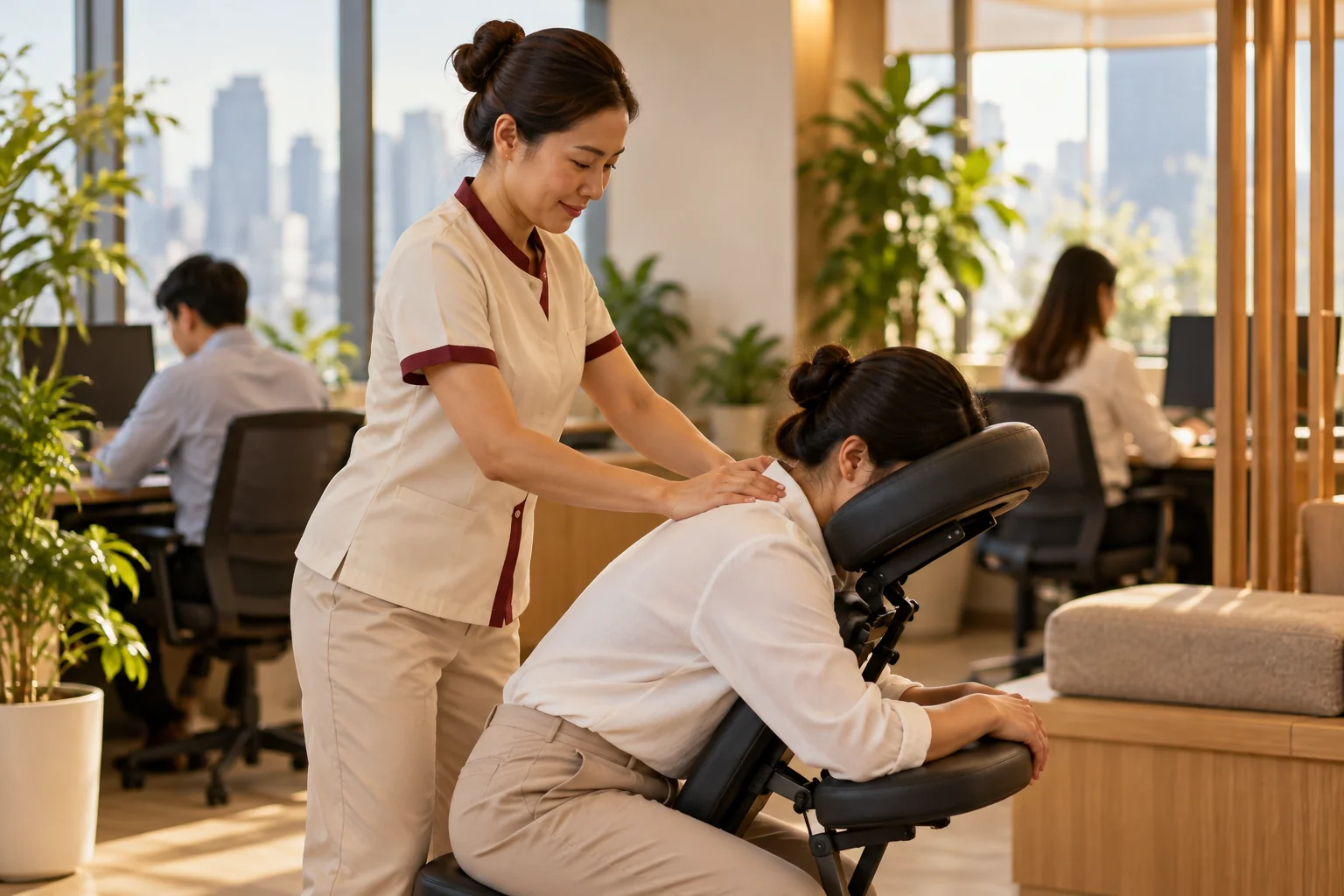
Most wellness budgets are spent on things that look good in a benefits deck and get used by eleven per cent of the staff. Gym memberships are the classic: enthusiastically taken up in January, quietly unused by March, and renewed annually because cancelling looks mean.
If the budget is modest and you want it used, on-site massage has an unusual property — it requires nothing of the person receiving it. No sign-up, no kit, no lunchtime sacrifice, no commitment to a habit they will feel guilty about abandoning.
Why it gets used when other things do not
Three reasons, and none of them is that massage is better than exercise.
It comes to them. The barrier to a gym is the journey, the bag and the shower. The barrier to a chair in a meeting room is standing up.
There is nothing to be bad at. A meaningful number of people avoid workplace fitness schemes because being unfit in front of colleagues is unpleasant. Nobody is unfit at a massage.
It is finite. A gym membership is a standing reproach. A wellness afternoon is an afternoon.
What it costs, concretely
Corporate office massage is ฿350 for fifteen minutes, ฿600 for thirty and ฿850 for forty-five, per person. Run the arithmetic for a real team rather than in the abstract:
| Team size | Session | Cost | Therapist time |
|---|---|---|---|
| 12 people | 15 minutes | ฿4,200 | One therapist, about four hours |
| 12 people | 30 minutes | ฿7,200 | Two therapists, about three and a half hours |
| 20 people | 15 minutes | ฿7,000 | Two therapists, about three and a half hours |
A quarterly afternoon for a team of twelve at thirty minutes each is ฿28,800 a year. That is a useful number to hold next to what the same company spends annually on unused gym memberships.
Quarterly beats monthly, and both beat one-off
A single wellness day is a nice gesture that is forgotten in a fortnight. Monthly is enough to become an expectation, which is a different and less grateful thing — and at thirty minutes a head it gets expensive quickly.
Quarterly is the interval that works. It is frequent enough that people plan for it and infrequent enough that it still registers as something the company chose to do. It also lets you time it: the week after a release, the end of a reporting period, the month when everybody is exhausted.
If the budget only stretches to one afternoon a year, put it in the hardest month rather than in December.
Spend it where the problem is
There is a real choice between treating everybody briefly and treating the people with an actual complaint properly.
Fifteen minutes each across a whole floor is a morale spend, and a legitimate one. Forty-five minutes for a smaller group is a different purchase: that is long enough to cover the neck, shoulders, upper back and forearms, which is the pattern desk work genuinely produces.
For individuals with an established problem rather than a tired team, office syndrome massage at ฿900 for forty-five minutes can be delivered at a desk and is built around exactly that pattern. Some companies run both: a short session for everyone, and a longer one for the people who have been saying their neck hurts since March.
Making the day work
The logistics are simple and the failure mode is always the same — an open invitation instead of a rota. A booking sheet with named slots, circulated the day before, is the difference between a day that runs to time and one where half the floor queues at noon. Planning a wellness day sets out the arithmetic in full.
Tell people it is through clothing, with no oil and no undressing. It removes the main reason people quietly decline.
We cover twelve Bangkok districts with no travel surcharge in any of them, and the service areas page has arrival estimates. The corporate page sets out the arrangement, booking for a visiting client covers the one-off version of the same spend, and if you send a request with your team size and the hours you want covered we will come back with how many therapists that needs and what it costs. The full treatment list is on the home page.
Frequently asked questions
How much does a wellness afternoon cost?
For twelve people at fifteen minutes each it is 4,200 baht and takes one therapist about four hours. At thirty minutes each it is 7,200 baht and needs two therapists for about three and a half hours. Twenty people at fifteen minutes is 7,000 baht. There is no travel surcharge in any of the twelve districts we cover.
How often should we run one?
Quarterly is the interval most companies settle on. A single day is a nice gesture that is forgotten in a fortnight, and monthly becomes an expectation rather than a treat and gets expensive quickly at thirty minutes a head. If the budget only stretches to one afternoon a year, put it in the hardest month rather than in December.
Is it better to give everyone fifteen minutes or a few people longer?
They are different purchases. Fifteen minutes across a whole floor is a morale spend and a legitimate one. Forty-five minutes for a smaller group covers the neck, shoulders, upper back and forearms, which is the pattern desk work genuinely produces. Some companies do both: a short session for everyone, and something longer for the people who have been saying their neck hurts since March.
Why do people decline a free massage at work?
Most often because they assume they will have to undress. Chair massage is worked through clothing with no oil and no changing, and saying so in the invitation removes the main reason for a quiet no. The other reason is a vague invitation, which is why a rota with named times gets far better take-up than an open door.


